

The high end of the market is not incidental to the American insurance crisis. It sits at the center of it.
In California, nine ZIP codes out of more than 1,700 account for roughly 7 percent of the FAIR Plan’s total liability exposure. Among them are Beverly Hills, Malibu and Bel Air. That is about $44 billion as of September 2025, and a 135 percent increase since 2022, according to a Bloomberg analysis of state data.
The FAIR Plan is California’s insurer of last resort. It exists for properties nobody else will write. That the most expensive neighborhoods in the state now make up a significant share of its book tells you how far private carriers have pulled back.
The supporting numbers are consistent. FAIR Plan enrollment grew 43 percent between September 2024 and December 2025, and the plan now covers more than 668,000 California homes, the highest count in its history. Total exposure reached roughly $750 billion by March 2026, a 242 percent increase since September 2022. CalMatters has reported close to 400,000 California policies cancelled since 2021.
The plan asked for a 35.8 percent rate increase. The California Department of Insurance approved 29.1 percent, effective October 15, 2026, which is still the largest single-year increase in the plan’s history. Separately, State Farm General received an emergency interim increase of 17 percent on homeowners policies under a March 2026 settlement with the department.
One figure makes the concentration plain. In California’s highest-risk ZIP codes, roughly 41 percent of residential structures now sit on a FAIR Plan policy. In lower-risk areas the figure is about 4 percent.
Florida tells a parallel story from the other direction, though the number you see quoted depends heavily on what is being measured. Insurify puts the statewide average at $8,292 a year, roughly 181 percent above the national figure, and projects about $8,458 by the end of 2026. Quotes for a standard $300,000 dwelling policy land lower, nearer $6,400. That spread is not sloppy reporting. It reflects how much of a Florida premium is wind coverage, and how much dwelling value sits behind it. California rates, meanwhile, are projected to rise about 16 percent in 2026.
Florida is the one part of this story where the direction has changed, though not quite in the way the headlines suggest. The clearest signal is depopulation. Citizens Property Insurance, the state’s insurer of last resort, has fallen from 1.42 million policies at its October 2023 peak to roughly 336,000, a decline of about 76 percent, as private carriers take the business back. Seventeen new insurers have entered the state since the 2022 and 2023 litigation reforms.
Citizens also approved an average statewide rate reduction of 8.7 percent for 2026, its first decrease since 2015. That figure is quoted constantly in Florida coverage, and it is worth knowing that it almost certainly does not apply to you. Citizens caps dwelling coverage at $700,000, or $1 million in Miami-Dade and Monroe counties, and limits personal liability to $100,000. A $2 million home is not eligible.
What matters at this end of the market is the second-order effect. As carriers return and compete for ordinary business, capacity frees up further up the value scale. Florida premiums remain the highest in the country. They are no longer climbing the way they were.
And the problem is no longer coastal. A Weiss Ratings analysis of 2025 data reported to the National Association of Insurance Commissioners found that Utah now has the highest insurer-initiated non-renewal rate in the country, ahead of both California and Florida. Minnesota, Colorado, Iowa, Illinois, Oklahoma, Louisiana and Michigan have all seen home insurance costs rise more than 35 percent since 2023.
Underwriters do not rate a house on how it looks. They rate it on roof age and material, construction type, distance to the nearest fire station, the presence of a pool, and claims history at the address. A modern luxury home tends to score poorly on several of those at once.
Flat Roofs: Why Modern Homes Use Them, and What They Cost
Flat roofs are not a stylistic accident. They produce the clean horizontal line the style depends on, they allow a usable roof deck, and they are cheaper to frame than a complex pitched assembly.
The cost arrives later.
Installed 2026 pricing for the common membranes runs roughly as follows. TPO costs $5 to $10 per square foot with a 20 to 30 year service life. EPDM runs $5 to $9, and its service life is the most debated number in the category. Contractor pricing guides commonly quote 25 to 30 years, while the EPDM Roofing Association’s 2025 survey of 569 roofing professionals puts properly installed and maintained membranes at 38 years or more. The association represents EPDM manufacturers, so read the high end with that in mind, but the field record is genuinely long. PVC is $7 to $12 with 25 to 30 years. Modified bitumen is the cheapest at $4 to $8, and the shortest lived at 15 to 25 years. These are contractor-reported installed ranges and vary widely with tear-off, insulation and roof complexity.
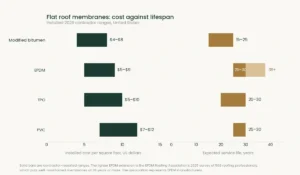
If you intend to keep the house, modified bitumen is false economy. It saves a dollar or two per square foot at install and costs you a full replacement a decade early. North of roughly the Virginia line I would take EPDM, because it is the easiest of the four to repair and has the longest field record. In hot climates white TPO earns its place on the cooling bill alone.
Two things make a luxury residential flat roof more expensive than those numbers suggest.
The first is complexity. A wide open commercial deck is the cheapest thing to install. A roof broken up by skylights, parapets, HVAC curbs and changes in elevation costs considerably more per square foot, because labor is spent on every penetration. Modern homes are full of penetrations.
The second is drainage. Standing water is the single biggest cause of flat roof failure. Adding tapered insulation to eliminate ponding costs another $1.50 to $3.50 per square foot, and skipping it is a common way to void a warranty.
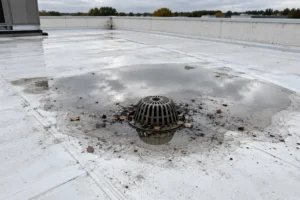
Maintenance is not optional either. Drains need clearing twice a year, seams need resealing roughly every five to seven years, and an annual professional inspection is standard practice. A clogged drain that lets water pool is how a small problem becomes a structural one.
In cold climates the calculation changes again. Snow load sits where it lands rather than shedding, which puts real weight on the structure and makes ice damming at the drains a genuine risk rather than a theoretical one.

There is one number that runs the other way. A white TPO membrane reflects over 80 percent of incoming solar radiation, which can cut cooling costs 15 to 25 percent in warm climates. On a large flat roof in Arizona or Texas, that is not trivial.
Floor-to-Ceiling Glass: The Trade-Offs Nobody Lists
Glass is the most expensive decision in a modern luxury home, and the cost is rarely quoted honestly up front.
A standard vinyl double-pane replacement window installs for roughly $400 to $700 per opening. Impact-rated glazing runs $1,000 to $3,800 per window in Florida, with contractor-reported national averages of $1,350 to $2,700 or more installed. U.S. News puts the impact premium at 20 to 40 percent above standard windows.
Multiply that across a wall of glass rather than a single opening and the figure stops being a line item.
In High Velocity Hurricane Zones, impact-resistant protection is not a choice. It is code for new construction and substantial renovation. Those zones cover Miami-Dade, Broward, Palm Beach and the coastal parts of Martin and St. Lucie counties. The Wind-Borne Debris Region extends the requirement to roughly anywhere within a mile of the coast or 1,500 feet of tidal water.
Three further costs are worth planning for.
Conditioning. A wall of glass is a wall with very little insulation value. It gains heat in summer and loses it in winter, which pushes HVAC sizing upward and keeps the system running longer. This is a permanent operating cost, not a one-time build cost.
Replacement and lead times. Large custom units from manufacturers such as Fleetwood, Western Window Systems or NanaWall are made to order. A single broken pane on a twelve-foot unit is not a same-week repair.
Cleaning. Ask, before the glass is specified, whether every pane can be reached without a lift. On a two-story glass elevation the honest answer is often no, and the cleaning contract becomes a recurring expense.
Here is the part a builder will not volunteer. The glass is usually the reason the house exists, so the question is not whether to have it. The question is how much of it faces west. West-facing glass is where the cooling bill gets decided, and it costs nothing to move on a drawing and a great deal to fix once the walls are up.
In wildfire zones there is one more consideration that rarely appears in a builder’s brochure. Glass typically fails before the structural frame does. Once an opening is breached, the interior is exposed. Underwriters in wildland-urban interface areas know this, and it is reflected in what they charge.
Open Floor Plans: Energy, Sound and Resale
The open plan is the least expensive of the three features to build and the most debated to live in.
The advantages are real. Sight lines, natural light penetrating deep into the house, and a sense of space that a compartmented plan cannot match.
The trade-offs are equally real, and they are mechanical rather than aesthetic. A single large volume must be conditioned as one zone, which means heating and cooling space nobody is occupying. Sound carries with nothing to stop it, which matters in a household where people work from home. Cooking odors travel the full length of the space. That is why the scullery has reappeared in high-end plans, a second working kitchen hidden behind the one guests see.
On resale, the picture is closer than the industry admits. A Rocket Mortgage survey cited by the National Association of Realtors found Americans split almost evenly, with 51 percent preferring an open layout and 49 percent preferring a more traditional, closed one. Anyone who tells you this is settled is selling something.
My own view is that the plan is rarely the real complaint. What people miss is having one room with a door on it. If the design gives you that somewhere, the open plan holds up fine.
What a $2 Million Modern Home Costs to Insure
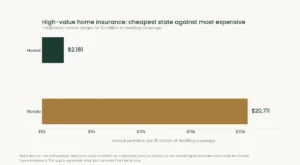
High-value home insurance from traditional carriers ranges from roughly $2,181 in Hawaii to $20,711 in Florida for $1 million in dwelling coverage, according to insurance.com’s state comparison. The spread is not a rounding error. It is close to ten to one.
Coverage above roughly $1 million typically moves out of standard products and into high-net-worth carriers or, increasingly, the Excess and Surplus market. E&S carriers write risks that admitted insurers decline. They cost more and carry fewer consumer protections, but they cover houses that would otherwise go uninsured. E&S grew to about 16 percent of one national agency’s policies by December 2025, up from under 2 percent in 2023.
Before buying in any of the affected states, get an insurance quote on the specific address during the inspection period rather than after. In parts of California and Florida, availability now shapes what a property is worth.
The Hurricane Deductible Most Buyers Miss
This is the number in the opening, and it deserves its own section because it surprises people.
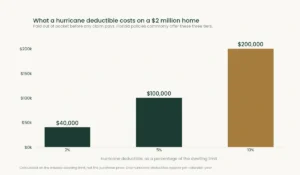
In coastal areas, windstorm and hurricane deductibles are calculated as a percentage of the insured dwelling limit, not as a flat dollar figure. In Florida the options commonly offered are 2 percent, 5 percent and 10 percent.
On a $2 million home, a 2 percent hurricane deductible is $40,000. At 5 percent it is $100,000. At 10 percent it is $200,000. That amount comes out of your pocket before any claim pays. On a personal residential policy, one hurricane deductible applies per calendar year.
Two things to verify before closing. First, whether the policy separates wind from other perils, because a named-storm deductible and a standard deductible are different numbers. Second, what the percentage is calculated against. It is the dwelling limit, not the purchase price.
What Actually Brings the Cost Down
Design decisions made before construction are far cheaper than retrofits, and several of them are rewarded directly.
In Florida the largest single lever is statutory. Florida Statute 627.0629 requires every residential property insurer to build actuarially reasonable windstorm mitigation discounts into its rate filings. This is a legal requirement, not a courtesy, and it covers private carriers and Citizens Property Insurance alike. Opening protection credits commonly run from about 10 to 45 percent of the windstorm portion of the premium, and Citizens applies up to an 88 percent maximum discount across all rated categories combined.
The credit is not automatic. It is triggered only by a licensed inspection documented on the OIR-B1-1802 Uniform Mitigation Verification Inspection Form, which was revised effective April 1, 2026. The report is valid for five years. The Florida Office of Insurance Regulation publishes current wind mitigation guidance for homeowners.
Two things worth knowing about what is not available. The federal Section 25C Energy Efficient Home Improvement Credit, which once returned up to $600 a year on qualifying windows, was repealed for property placed in service after December 31, 2025, and there is no equivalent federal replacement. And the My Safe Florida Home grant, frequently cited in window marketing, is restricted for the current cycle to low and moderate income households with an insured value cap of $700,000. Neither applies to a home in this price range.
What does apply: wind mitigation upgrades, hurricane-rated roofing and IBHS FORTIFIED certification reduce premiums meaningfully even on seven and eight figure properties. Roof age and material carry real weight. So does distance to the nearest fire station, which is worth checking before you buy the lot rather than after.
Questions to Ask Before You Build
If you ask only one of these, ask the first. It is the only question on the list that can end a purchase, and it is the one most buyers leave until the inspection period has already closed.
- What is the insurance quote on this specific address, from a carrier that will actually write it?
- Is the hurricane or windstorm deductible a percentage or a flat amount, and of what?
- What membrane is specified on the roof, and does the quote include tapered insulation?
- Can every pane of glass be cleaned without a lift?
- What is the lead time to replace the largest glass unit in the house?
- Is the glazing impact rated, and do you have the product approval number?
- How far is the nearest fire station, and does the carrier rate on it?
- Will the design qualify for IBHS FORTIFIED, and what would it take to get there?
The Bottom Line
None of this is an argument against building a modern house. The glass is the point. The flat roof is the point. Nobody builds this way by accident.
It is an argument for getting one number before you commit, and that number is the insurance quote on the specific address, from a carrier that will actually write the policy. Not a national average. Not what the neighbor paid three years ago. That address, this year.
Every other cost on this page is one you can plan around. A roof membrane is a choice. Glazing is a choice. Where the windows face is a choice. Insurance is the only one on the list that somebody else decides for you, and in parts of California and Florida it now decides what a property is worth before you have finished deciding whether you want it.
Frequently Asked Questions
Are flat roofs a problem in cold climates?
They require more management. Snow sits rather than shedding, which loads the structure and raises the risk of ice blocking drains. Flat roofs work in cold climates when drainage is properly tapered, insulation is adequate, and drains are cleared before winter. Skipping any of the three is where failures start.
Do floor-to-ceiling windows raise insurance costs?
Indirectly, yes. Underwriters rate construction type and exposure rather than window size specifically, but large glazed areas increase vulnerability in both wildfire and wind-borne debris zones. Impact-rated glazing reverses the effect: in Florida, state law requires carriers to credit verified opening protection, commonly 10 to 45 percent off the windstorm portion of the premium.
How much does it cost to insure a $2 million home?
It depends almost entirely on the state. High-value coverage from traditional carriers ranges from about $2,181 in Hawaii to $20,711 in Florida per $1 million of dwelling coverage. Homes above $1 million usually require a high-net-worth carrier or the Excess and Surplus market.
What is a hurricane deductible?
A separate deductible that applies only to named-storm or windstorm damage, calculated as a percentage of the insured dwelling limit rather than a flat sum. Florida policies commonly offer 2, 5 or 10 percent. On a $2 million home that is $40,000, $100,000 or $200,000 paid before coverage begins.
How long does a flat roof last on a luxury home?
Between 15 and 30 years depending on membrane. PVC lasts 25 to 30 years, TPO runs 20 to 30, and modified bitumen 15 to 25. EPDM has the longest field record, with its trade association putting well-maintained membranes at 38 years or more. Reaching the upper end requires clearing drains twice yearly and resealing seams every five to seven years.