

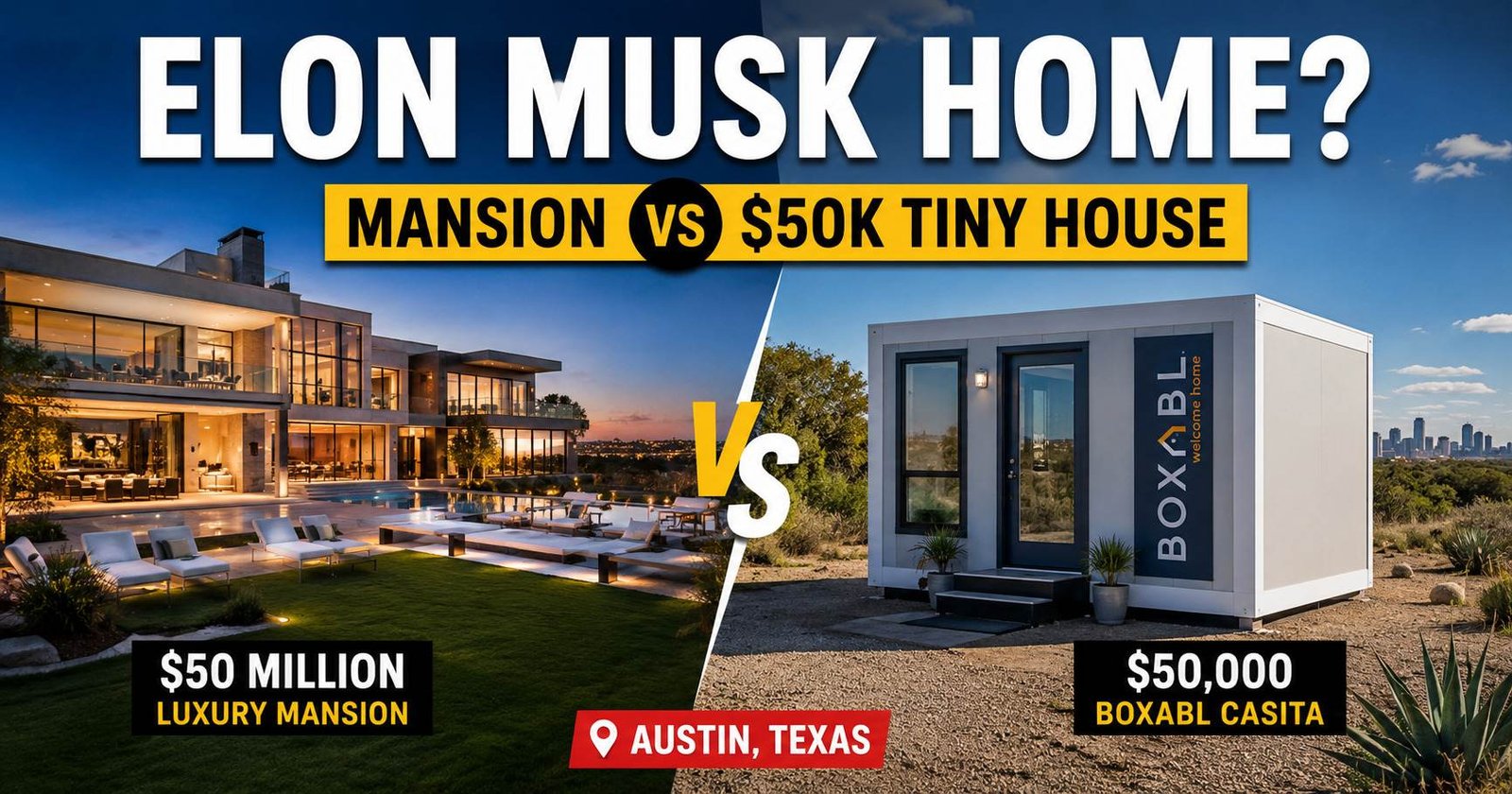
When most people imagine billionaire living, they picture sprawling estates with infinity pools, home theaters, and staff quarters. But Elon Musk? He turned that whole image upside down when he announced he was selling his California mansions and downsizing dramatically in Texas.
And honestly, the reality is more interesting than the headline. The popular version of the elon musk home story, the one where a trillionaire lives full-time in a single $50,000 folding box, isn’t quite accurate. The truth sits somewhere in between minimalist legend and ordinary rich-person real estate, and that gap is what makes this topic worth digging into.
In this guide, we’ll walk through everything about the elon musk home situation. Where he actually lives, what the small Texas place is really like, the Boxabl confusion, his Austin properties, and the philosophy behind his downsizing. Whether you’re here for celebrity real estate, tiny living, or housing trends, you’ll get the full picture, not just the viral one.
The information here is drawn from Musk’s own public statements, his biographer Walter Isaacson, court filings, and coverage from outlets including The Wall Street Journal, Business Insider, and Fortune. Where something isn’t formally confirmed, it’s labeled that way.
Quick Answer – Where Does Elon Musk Live Now?
Musk is most closely associated with a small prefabricated home near Boca Chica, Texas, beside SpaceX’s Starbase. He has said that small Boca Chica home is rented from SpaceX rather than owned by him personally. He has separately stated he owns a Boxabl Casita, which he uses as a guest house, not as his main residence. He is also linked to larger properties near Austin, so the “lives only in a tiny house” framing oversimplifies things.
Elon Musk Home Quick Facts
| Category | Details |
| Main Texas base | Small prefab home near Boca Chica / Starbase (rented from SpaceX, per Musk) |
| Size | Roughly 375 to 400 square feet |
| Estimated cost | Around $50,000 for the small Texas unit |
| The Boxabl | A ~375 sq ft Casita he says he owns and uses as a guest house |
| Other property | Linked to Austin-area homes (West Lake Hills), valued in the millions |
| Why Texas | Proximity to SpaceX, lower taxes, privacy, family |
Why Elon Musk’s Home Attracts Global Attention
When people think of billionaires, they usually picture sprawling estates, private islands, and palatial mansions with countless rooms.
So when the world’s richest person started talking about living in a tiny house in Texas? People paid attention.
The contrast is striking. Someone worth hundreds of billions choosing to spend nights in a space smaller than most American apartments goes against everything we expect at that wealth level. It’s the kind of detail that travels fast online, sometimes faster than the facts behind it.
There’s also a deeper thread here. Musk has talked for years about shedding possessions and focusing his energy on work, and the housing story slots neatly into that narrative. “Possession just weighs you down,” he wrote on X, adding that he wasn’t getting rid of his properties for the money but to devote himself to Mars and Earth.
The public fascination goes beyond curiosity. Some want to know whether it’s genuine or partly stagecraft. Others wonder if simplicity really sharpens focus. And plenty of regular homeowners are quietly asking the most useful question of all: is there anything here I can actually apply to my own housing choices?
Where Is Elon Musk Home Located?
The Texas home most tied to him sits in Boca Chica, a small community in the southernmost tip of the state, right along the Gulf Coast.
This isn’t your typical celebrity neighborhood. No gated mansions. No luxury shopping. The main landmark nearby is SpaceX’s Starbase launch facility, where the company builds and tests the rockets meant to reach Mars. In May 2025, Starbase was formally incorporated as a city.
The exact elon musk home address stays private for security reasons, which is standard for someone at his profile. The general area is well documented, though, and the small structure has been photographed near SpaceX operations.
That privacy point explains something a lot of people run into. Search for elon musk home photos and you’ll find plenty of images of the Boxabl Casita model and the general Boca Chica area, but very few verified, up-close looks at his actual current residences. For high-profile figures with serious security needs, that’s by design. The interiors and exact layouts of his personal homes simply aren’t part of the public record the way a celebrity’s listed mansion might be.
Putting the elon musk residence right beside the launch site makes practical sense. From a real estate standpoint, it’s a textbook case of buying location over square footage. He’s optimizing for a two-minute walk to work, not for a view or resale comps.
Why Texas Fits Elon Musk’s Lifestyle
A few practical advantages line up neatly with how he runs things.
Start with SpaceX. Starbase has become the center of gravity for Starship development, and living on top of it cuts commute time to almost nothing. When an engineering problem comes up at 2 a.m., proximity matters.
Then there’s the tax picture. Texas has no state income tax, which is meaningful even at his level, and he has openly criticized California’s taxes and regulations. The move out of California around 2020 was very public and very deliberate.
Finally, the open landscape and low density mean fewer distractions and easier security. For someone juggling SpaceX, Tesla, xAI, and more, a quiet base beats a busy city address.
Elon Musk Tiny House in Texas (Boxabl Casita)
Here’s where the story gets tangled, so it’s worth slowing down.
For years, headlines claimed Musk lived in a $50,000 Boxabl Casita, a foldable prefab home from a Las Vegas startup. The image was irresistible: futuristic box, rocket launchpad, minimalist billionaire. Back in November 2020, Boxabl revealed it had installed one of its prefab homes in Boca Chica for a “top secret customer,” and the rumor mill did the rest.
But Musk pushed back on the specifics. He said on Twitter that he had been living in a roughly $50,000 house in south Texas, “not Boxabl,” while still praising the product. He later said in July 2022 that he owns a Boxabl and uses it as a guest house, and even mentioned throwing a birthday party there.
So the cleanest way to describe it: a Boxabl Casita is associated with him and sits near Starbase, he owns one and uses it as a guest unit, but he has said it isn’t his primary home.
As a product, the Casita is genuinely interesting. It’s a roughly 375-square-foot prefab that starts around $49,500. It comes with a full bathroom, a kitchen with appliances, tall ceilings, and big windows, and it can be assembled in about an hour. The unit ships nearly move-in ready, which is the whole pitch behind modular housing: build in a controlled factory, deliver fast, cut waste.
Why Elon Musk Chose a Tiny Home
Whatever the exact structure, the downsizing instinct is real, and he’s explained it more than once.
The first reason is focus. Big properties demand time, staff, landscaping, and constant upkeep, all of which pull attention away from work. A small place erases most of that.
The second is temperament. He doesn’t seem to value owning things he rarely uses, and a large house is full of rooms that mostly sit empty. His biographer captured the mood well. Walter Isaacson described a “spartan two-bedroom house in Boca Chica” where Musk would sit at a wood table and make calls.
There’s a financial logic too, even if it’s almost beside the point at his scale. And there’s the symbolic angle: spending lavishly on housing sits awkwardly next to a stated mission of getting humanity to Mars. He has called the small home “kinda awesome,” which tells you he isn’t suffering through it.
How Prefabricated Homes Work
Prefab construction flips the usual building process on its head. Instead of assembling everything on a muddy lot over many months, most of the work happens indoors at a factory.
Crews frame walls, run wiring, install plumbing, and finish interiors under one roof. Quality control gets easier because conditions never change, and weather can’t stall the schedule.
When the unit is done, it heads to the property. Some prefab homes arrive in sections and get bolted together on-site. Others, like the Casita, fold for transport and open up once delivered.
Installation is quick. Prep a pad, set the home, unfold it, hook up utilities. What might take half a year the traditional way can wrap in days.
The cost advantage is the part the housing industry keeps watching. Factory production trims labor and material waste, and buying supplies in bulk pulls prices down further. For a market wrestling with affordability, that math is exactly why modular construction keeps gaining ground.
Inside Elon Musk Home – Interior Tour
Since the exact interior of his rented Boca Chica home isn’t fully public, the clearest window into this style comes from Boxabl’s own published Casita layouts, which the home is so often compared to. Treat the details below as representative of the format rather than a confirmed walkthrough of his personal space.
The vibe is modern minimalist. Clean lines, neutral tones, and open sightlines stretch a small footprint so it doesn’t feel boxed in. Light does a lot of the work, with windows placed to brighten the room without giving up privacy.
Living Area
In a Casita-style layout, the living area pulls double or triple duty. Relax, work, eat, host, all in one zone.
Furniture stays minimal. Think a compact sofa, a small table, maybe a chair or two, with storage tucked into the walls so the floor stays clear.
Tech blends in. A wall-mounted screen, well-placed outlets, charging spots within reach. It handles modern life without the clutter.
Kitchen Design
Boxabl says the Casita kitchen includes a refrigerator, dual sinks, an oven, a dishwasher, a microwave, cabinets, and a dining table that connects to the countertops. Compact, but more complete than people expect from a “tiny” home.
Counter space is limited, which naturally nudges you toward simpler cooking. For someone who has talked about eating fast and plainly, that’s a feature, not a flaw.
Bedroom Setup
The sleeping area is small and private. In compact prefab layouts, a fold-away or built-in bed is common, freeing up floor space during the day.
There isn’t much beyond the essentials. A shelf or nightstand for a phone, a book, a lamp, and built-in storage sized for a modest wardrobe.
The whole point is rest, not entertainment. No office, no TV competing for attention. Just a place to sleep.
Bathroom Layout
The bathroom packs a shower, toilet, and sink into a tight, efficient footprint. Space-saving fixtures keep it usable without feeling cramped, and a small cabinet handles the basics.
It’s practical and easy to clean, and high-efficiency fixtures help trim water and energy use, which fits the broader sustainability thread running through this kind of home.
Exterior Design and Layout of Elon Musk Home
The small Texas home is intentionally plain. It doesn’t broadcast wealth, and that’s the point.
From outside it reads as a simple, modern structure: clean lines, minimal decoration, a footprint that barely touches the land. That compact footprint is part of the environmental appeal and makes placement flexible, even on sites where a conventional build would be a headache.
Materials lean durable and low-maintenance, chosen for longevity rather than curb appeal. Sitting near an active launch facility, the home reads as functional architecture meant to support work, not impress guests.
Smart and Energy-Efficient Features
Compact prefab homes in this category usually lean hard into efficiency, and the Casita-style design is no exception.
Solar pairs naturally with this kind of unit. Tesla panels and battery storage can integrate cleanly, which opens the door to generating power on-site and, in the right setup, running largely off-grid.
Insulation does the heavy lifting in a small envelope. Strong R-value insulation in the walls and ceiling keeps the interior stable while holding down heating and cooling costs, which matters a lot in the Texas heat.
Energy-efficient windows help too. Double or triple-pane glass cuts heat transfer, and smart placement pulls in daylight while limiting harsh afternoon sun. Add LED lighting and efficient appliances, and the whole system is built to sip energy rather than gulp it.
Sustainability Philosophy Behind the Home
Musk has spent years pushing sustainable energy through Tesla, SolarCity, and battery tech, so a small, efficient home lines up with the public message.
The truth is, the tiny house movement has been building momentum on its own for a while, as more people clock the environmental upside of living smaller. Less energy, fewer materials, a lighter footprint. It adds up.
What his case shows is that simplicity and comfort aren’t opposites. You can have a clean, functional, livable space without the resource load of a 10,000-square-foot house.
Elon Musk Home Price and Ongoing Costs
The small Texas home is famously cheap by celebrity standards. Around $50,000, which is a rounding error for someone at his net worth and a fraction of what a typical American home costs.
Worth repeating, though: he has said the Boca Chica home is rented from SpaceX rather than owned outright. So the headline price tag describes the type of structure more than a personal purchase.
Running costs for a 375-to-400-square-foot home are naturally low. Heating and cooling a small space takes little energy, and there’s simply less to maintain. From a real estate angle, that’s the underrated win of small homes: the savings show up every single month, not just at closing.
For context, the average US home price sits in the high six figures in many markets. Set that against a roughly $50,000 prefab, and the elon musk house cost story becomes a neat illustration of just how wide the housing spectrum really is.
Value Over Luxury
This setup prioritizes function over appearance. Shelter, privacy, proximity to work. No status signaling.
That cuts against the usual script, where rising income means a bigger house almost automatically. Square footage becomes a scoreboard.
The flip here is the interesting part. A home that fits your actual life can be worth more, in real terms, than a mansion full of rooms nobody enters. Plenty of downsizers reach the same conclusion long before they hit billionaire money.
Why Elon Musk Sold His Mansions
In 2020, he announced on social media that he planned to sell almost all of his physical possessions, homes included. Then he actually did it, listing property after property in California.
His reasoning was blunt. Owning things was weighing him down, and managing real estate ate time he’d rather spend on SpaceX and Tesla. There was a mission angle too, tied to Mars and sustainable energy, where a luxury portfolio felt out of step.
Some people were skeptical. Publicity move? Tax play? Fair questions. But the sales were real and the move to Texas stuck, so the core of it reads as sincere even if the “minimalist monk” packaging was a little too tidy.
In many ways the shift mirrors a broader trend among high-net-worth individuals who are rethinking what they actually want from property. Minimalism stopped being only a budget strategy. For some, it’s now a deliberate choice about focus and freedom.
Elon Musk Real Estate History (Before the Tiny Home)
Before any of the downsizing talk, his portfolio looked exactly like you’d expect from a tech billionaire. Large, luxurious, mostly clustered in California.
Trace the homes Elon Musk bought across the stages of his career and you can almost map his rising wealth. The early years brought California properties as the businesses scaled, the Bel Air era marked the peak of the trophy-mansion phase, and the Texas purchases after 2020 signaled a sharp change in priorities. The buying never really stopped. What changed was the kind of property and the reasons behind it.
His Bel Air holdings included multiple adjacent mansions with pools, guest houses, and expansive grounds, together worth well over $100 million. There was a Hillsborough estate too, picked up for $23.4 million, with seven bedrooms and extensive grounds, the kind of trophy property that defines high-end celebrity real estate.
The architecture ranged from mid-century modern to contemporary custom builds. Each place fit the conventional luxury playbook: big, polished, designed to impress. Looking back, the contrast with a 375-square-foot prefab is almost comic, which is part of why the story caught fire.
The Gene Wilder Home and Ad Astra School
One property carried more weight than the rest. He bought the former home of actor Gene Wilder in Bel Air, a place with real architectural character and history.
When it came time to sell, he attached an unusual condition: the buyer had to preserve the home’s legacy rather than tear it down. That’s a telling detail for someone often framed as purely transactional.
The house was also tied to Ad Astra, the small private school he created for his children and the kids of SpaceX employees, with a focus on problem-solving and hands-on learning over standard curriculum. Some homes, clearly, meant more to him than their price tags.
Elon Musk Austin Homes and the Fuller Picture
This is the part the viral version usually skips, and it changes the whole story.
While the tiny-house headlines circulated, he was quietly buying in Austin. Court filings from his custody dispute with Grimes show he purchased a home in February 2022 and stated he still lived there, after a previously rented address became public. The house was bought through an LLC overseen by a wealth-management firm, a common privacy move for high-profile owners.
Public coverage has filled in more. Business Insider and The New York Times described a six-bedroom mansion in West Lake Hills, an affluent area near Austin, that Musk bought in 2022 for around $6 million. He then drew complaints, and a zoning fight, after erecting a 16-foot fence and gate that violated several city ordinances, ultimately losing an appeal in April 2025 before narrowly prevailing later that spring.
The picture gets bigger still. Public reporting indicates he has spent around $35 million on a set of contiguous Austin properties, including a 14,400-square-foot mansion, with suggestions that he hopes to build a compound where his children and their mothers could live. According to The Wall Street Journal, he also sometimes stays in two penthouses inside the Austin Proper Hotel and Residences.
None of this erases the downsizing. He genuinely sold a large California portfolio and lives modestly near Starbase much of the time. But “the billionaire who owns almost nothing” isn’t accurate either. He’s very much a property owner again, just a more private and unconventional one.
How Many Homes Does Elon Musk Own Today?
So, how many homes does elon musk own? Honestly, the exact count is murky on purpose, since several properties are held through LLCs for privacy.
What’s clear is that the simple “just one tiny house” answer is wrong. His main working base is the small rented home near Starbase. Separately, he owns a Boxabl Casita used as a guest unit, plus the Austin-area properties described above.
As Business Insider summed it up, despite claims of couch-surfing and minimalism, Musk became “a homeowner again,” having bought in Austin and lived there since 2022. Compared with billionaires who openly maintain estates around the world, his footprint is still relatively restrained. It’s just not as monk-like as the legend suggests.
Elon Musk Home vs Traditional Celebrity Mansions
Set the small Texas home against a standard A-list mansion and the gap is almost absurd.
Most celebrities at his wealth level own 10,000 to 20,000 square feet or more, packed with theaters, gyms, wine cellars, and guest wings. A 375-square-foot home could disappear inside one of their primary suites.
The real difference, though, isn’t size. It’s intent. Traditional luxury homes are built to entertain, to display, to signal arrival, and they come with full-time staff and four-figure monthly utility bills. The small Texas home is built to be ignored. It costs little, asks for almost nothing, and stays out of the way.
What Makes Musk’s Choice Unusual
Billionaires almost never trade down. Wealth usually buys more space, not less.
Breaking that pattern is the headline-grabbing move. Choosing less when you could buy anything reads as either eccentric or shrewd, depending on your view. There’s also a quiet confidence in it. He doesn’t need a mansion to prove anything, so the house works as a tool rather than a status symbol. The Austin properties just complicate the “pure minimalist” reading a bit.
What Homeowners Can Learn From Elon Musk Home
You don’t need a rocket company to take something useful from all this. A few lessons translate cleanly.
Smaller homes save real money. Lower purchase price, lower utilities, less maintenance, and those savings compound year after year toward debt, investing, or whatever matters more to you than extra rooms.
Location can beat size. Living close to work or the things you value daily improves quality of life in ways square footage never does. Real estate pros say it constantly: you can change a house, you can’t change where it sits.
Design for how you actually live, not the life you imagine you’ll live someday. Unused space is money and energy quietly draining away.
And remember the hidden costs of ownership. Every extra room is more to clean, fix, and manage. Simplifying can buy back time, which is the one thing no mortgage gives you.
Lessons for First-Time Buyers
New buyers often feel pushed toward the biggest home they can finance. There’s a calmer path.
Buy what you need, not what the bank approves. Qualifying for a large mortgage isn’t the same as it being wise. Smaller payments mean breathing room.
It’s also worth looking at prefab and modular options seriously. They’ve shed the cheap reputation and increasingly offer solid construction at lower prices. Then think long-term about upkeep, and pick a place that fits your life instead of consuming it.
Lessons for Real Estate Investors
For investors, the takeaway is value over flash. Not every property needs luxury finishes and maximum square footage, and demand for affordable, efficient housing is strong and growing.
Proximity to jobs, transit, or amenities tends to drive value more reliably than raw size, so location-led plays often outperform big homes in weaker spots. And sustainability features, solar, efficient systems, eco-friendly materials, increasingly attract buyers and renters who’ll pay for lower running costs.
The Bigger Housing Trend Behind Musk’s Choice
Strip the celebrity out of it and his housing decision lands on top of some of the most active conversations in real estate right now.
Affordability is the engine. With home prices and mortgage rates squeezing buyers across the US, UK, and Canada, the appeal of a smaller, cheaper, well-built home is no longer fringe. The tiny home movement grew out of exactly this pressure, and it has matured from a lifestyle experiment into a serious option for first-time buyers, downsizers, and people chasing flexibility.
Modular and prefab housing sit at the center of that shift. Factory-built homes can go up faster and cheaper than traditional construction, and the quality gap that once scared people off has narrowed considerably. Builders and even some governments have started leaning on modular methods to address housing shortages, because you can’t pour concrete fast enough to fix a supply problem, but you can scale a factory line.
The future of prefab housing likely looks less like a novelty and more like infrastructure. Expect tighter integration with solar and storage, smarter compact layouts, and steadier mainstream acceptance as supply pressures persist. Seen in that light, Musk’s setup isn’t really an outlier. It’s a high-profile version of a direction the broader market is already moving, which is part of why his housing choice resonated well beyond the usual celebrity-real-estate crowd.
Pros and Cons of Living in a Tiny Home Like Elon Musk
Pros
Cost is the obvious one. Price, utilities, insurance, and maintenance all drop sharply.
Life gets simpler. Less to clean, less to organize, faster routines. There are environmental upsides too, with smaller footprints and lower energy use across the home’s life. And flexibility improves, since selling or relocating is far easier when you’re not anchored to a large property.
Cons
Space is tight, plainly. Storage is limited, and there’s little room for guests, hobbies, or collections.
Privacy can be tough, especially for families sharing one small footprint. Resale can be uncertain, since tiny and prefab homes don’t yet have the deep, established market that traditional housing enjoys. And zoning is a real hurdle. Many areas restrict where small prefab structures can legally sit, so do your homework before buying one.
Common Myths About Elon Musk Home
A lot of confusion has built up here, so let’s clear the big ones.
He’s not homeless and never was. He has a home near Starbase, plus property in Austin. The “couch-surfing billionaire” framing was always overstated.
He’s not anti-property either. Selling mansions wasn’t a rejection of ownership, just a shift in priorities, and the Austin purchases prove the point.
And the most stubborn myth: that he lives full-time in a Boxabl Casita. He has said plainly that the Boxabl is a guest house and that his small Texas home is a different unit. Small doesn’t mean uncomfortable, and the legend doesn’t quite match the paperwork.
Elon Musk Birthplace and How His Background Shapes His Lifestyle
The elon musk birthplace is Pretoria, South Africa, where he was born in 1971. His upbringing wasn’t defined by luxury.
An engineer’s mindset runs through how he handles most things, housing included. Efficiency, function, cutting waste. Those instincts apply whether you’re designing a rocket or sizing a kitchen.
Growing up outside the US may shape his view of wealth and status too, giving him a slightly different reference point for what “success” should look like at home. Add a background in physics and economics, fields built on optimization and systems thinking, and the lean toward a practical, stripped-down living setup starts to make sense.
Future Housing Plans – Could Elon Musk Change Homes Again?
Probably, if it suits the work. His housing decisions tend to follow business needs, and those shift constantly.
If SpaceX’s center of gravity moves, he could move with it. He’s shown he’ll relocate when it serves a goal. New housing tech could nudge him too. If modular construction keeps advancing, he’s exactly the type to adopt the next version early.
The underlying philosophy of simplicity seems likely to stick even as specific addresses change. He’s also floated, half-seriously, the idea of eventually living on Mars. Decades away at best, but it captures how far ahead he tends to think about where, and how, people live.
Frequently Asked Questions (FAQs)
Where does Elon Musk live right now?
His main Texas base is a small prefabricated home near Boca Chica, beside SpaceX’s Starbase, which he has said is rented from SpaceX. He’s also linked to larger properties in the Austin area.
What type of house does Elon Musk live in?
A compact, modern prefab-style home near Starbase. He separately owns a Boxabl Casita, a roughly 375-square-foot foldable prefab, that he says he uses as a guest house rather than his primary residence.
What does Elon Musk’s house look like inside?
The small Texas home has been described as spartan and functional. Comparable Boxabl Casita layouts include a living area, a fully equipped kitchen, a bedroom space, and a bathroom, all designed for efficiency.
How much does Elon Musk’s home cost?
The small Texas home is widely cited at around $50,000, far below typical US home prices. Note that he has said it’s rented rather than purchased, so the figure reflects the unit type more than a personal buy.
Does Elon Musk own or rent his home?
He has said the Boca Chica home is rented from SpaceX. He does, however, own other property, including Austin-area homes purchased through an LLC, according to court filings.
Does Elon Musk still own mansions?
He sold his large California portfolio, but he’s since bought in Austin, including a six-bedroom West Lake Hills mansion and a larger set of contiguous properties. So yes, he owns substantial property again, just more privately.
Why does Elon Musk prefer a small house?
He has said large properties demand time and attention he’d rather give to work, and that possessions “weigh you down.” A small home near Starbase keeps him close to operations with minimal upkeep.
Can anyone buy the same type of home Elon Musk uses?
Yes. Boxabl sells the Casita to the public, starting around $49,500. Just check local zoning and building codes first, since not every area permits small prefab units.
Is Elon Musk’s home open for public tours?
No. His homes are private residences and are not open for public tours or visits. Locations are kept private for security reasons.
Conclusion – What Elon Musk Home Really Represents
Strip away the viral packaging and the elon musk home story is still a good one. It’s just more honest as a mix than as a myth. A genuinely modest base near his rocket factory, a guest-house Casita that the internet turned into a legend, and a quieter set of Austin properties that prove he never really stopped being a homeowner.
What’s worth keeping is the underlying idea. Comfort and meaning don’t scale automatically with square footage. A small, intentional home can carry a full life when it’s matched to how someone actually lives and works.
For the rest of us, the lessons travel well. Let your home serve your life instead of running it. Weigh location and function over size and signaling. Notice when space stops adding value and starts quietly draining it.
You don’t need a launchpad in your backyard to ask the useful questions. Does your home add to your days or subtract from them? Does it create freedom or demand constant maintenance? Could living a little smaller free up time, money, and headspace for what you actually care about?
Those aren’t easy questions. But they’re the ones worth sitting with. And the most interesting part of this whole story isn’t the price tag or the folding walls. It’s the reminder that home, in the end, is measured less in square feet and more in how well it fits the life you’re trying to build.