

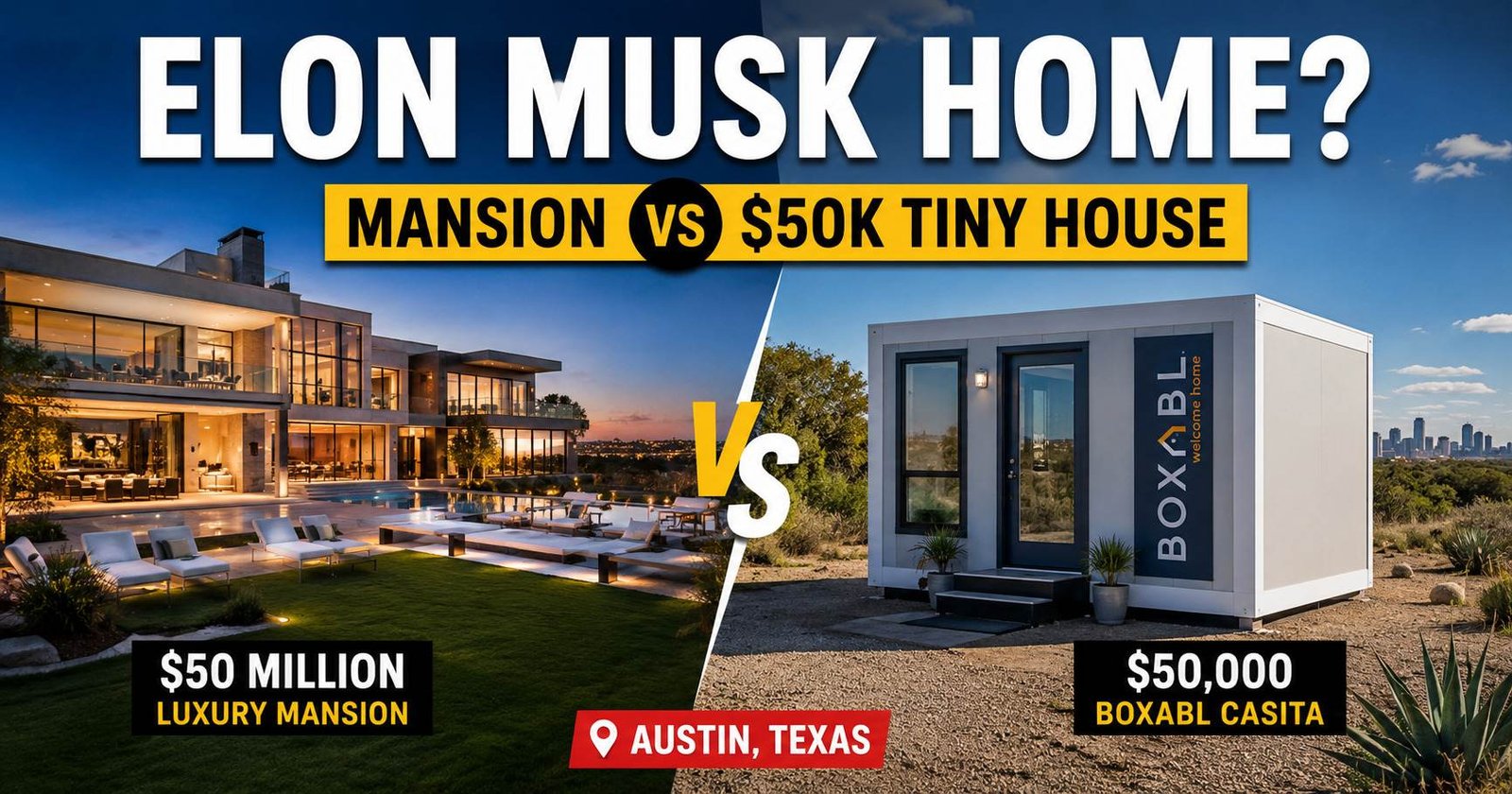
When most people imagine billionaire’s living, they picture sprawling estates with infinity pools, home theaters, and staff quarters. But Elon Musk? He turned that whole image upside down when he announced he was ditching his California mansions for a far simpler life in Texas, a move that quickly became tangled up with stories about a tiny prefabricated home.
And honestly, this appears to be a genuine lifestyle shift rather than some temporary arrangement. It’s sparked conversations worldwide about what we truly need from our homes. Musk’s choice raises some fascinating questions about minimalism, sustainability, and whether bigger really does mean better.
In this complete guide, we’ll explore everything about the elon musk home, separating what’s confirmed from what’s myth. From its location and interior layout to the philosophy behind his radical downsizing, and the properties he’s actually been linked to since. Whether you’re curious about celebrity real estate, interested in tiny living, or simply want to understand why one of the world’s wealthiest people leaned toward simplicity, you’ll find accurate answers here.
The information in this article comes from Musk’s own public statements, interviews with major news outlets, company announcements, and verified real estate reporting.
Quick Answer – Where Does Elon Musk Live Now?
Elon Musk’s primary base is near Boca Chica, Texas, now the incorporated city of Starbase, right beside the SpaceX Starbase facility. For years, his main residence there was described as a modest, small house. Importantly, Musk has publicly clarified that this primary home is not a Boxabl unit, though he does own a Boxabl Casita tiny house, which he uses as a guest house near the launch site. Since then, he has also been linked to larger properties in the Austin area.
So the popular “billionaire lives in a $50,000 tiny house” headline is partly true and partly myth, and this guide explains exactly which is which.
Elon Musk Home Quick Facts
| Category | Details |
| Primary location | Boca Chica / Starbase, Texas (beside SpaceX) |
| Primary home type | Modest small house (reportedly rented from SpaceX) |
| Famous tiny house | Boxabl Casita used as a guest house, not main residence |
| Casita size | Approximately 375 square feet |
| Casita estimated cost | ~$49,500–$60,000 (base unit) |
| Manufacturer | Boxabl (Las Vegas-based company) |
| Other properties | Linked to homes in the Austin, Texas area |
| Primary purpose | Proximity to work, minimal maintenance, simpler living |
Why Elon Musk’s Home Attracts Global Attention
When people think of billionaires, they usually picture sprawling estates, private islands, and palatial mansions with countless rooms.
So when reports surfaced that Elon Musk was associated with a tiny house in Texas, the world took notice.
The contrast is striking. Here’s someone worth hundreds of billions of dollars connected to a space smaller than most American apartments. This decision challenges everything we expect from someone at his wealth level.
His housing choices also reflect his broader philosophy about innovation and efficiency. Musk has consistently talked about eliminating unnecessary possessions and focusing energy on work that matters. In 2020, he famously pledged to sell almost all of his physical possessions, saying ownership “weighs you down.”
His home isn’t just a place to sleep. You could say it represents a statement about what he values and how he wants to spend his time.
The public fascination goes beyond simple curiosity. People want to understand whether this lifestyle choice is genuine or strategic.
They wonder if living simply actually improves focus and productivity. Most importantly, they’re asking whether ordinary homeowners can learn something valuable from his approach.
Where Is Elon Musk Home Located?
The elon musk residence sits in Boca Chica, a small community in the southernmost tip of Texas, right along the Gulf Coast, an area that was officially incorporated as the city of Starbase in May 2025.
This isn’t your typical celebrity neighborhood. No gated communities here. No luxury shopping centers or five-star restaurants nearby.
Boca Chica is remote and quiet. The area is primarily known for its proximity to SpaceX’s Starbase launch facility, where the company develops and tests rockets for missions to the Moon and, eventually, Mars.
The location makes perfect sense for someone who spends most of his time working on space exploration.
The exact elon musk home address remains private for security reasons, but the general area is well documented. Notably, Musk has said the small Boca Chica home is rented from SpaceX rather than owned by him personally, an arrangement that keeps him close to launch operations.
The home location puts Musk very close to rocket test sites and engineering labs.
Privacy is another benefit. Unlike Los Angeles or San Francisco, Boca Chica doesn’t attract paparazzi or tourists looking for celebrity sightings.
Musk can move more freely between his home and work without constant interruption.
Why Texas Fits Elon Musk’s Lifestyle
Texas offers several practical advantages that align with how Musk approaches both business and personal life.
First, SpaceX operations are expanding rapidly in the state. Starbase is becoming the central hub for Starship development, the vehicle designed to carry humans to Mars. In 2024, Musk announced SpaceX would relocate its official headquarters to Starbase.
Living nearby eliminates commute time. It allows Musk to respond quickly when engineering challenges arise.
Second, Texas has no state income tax. That provides significant financial benefits even for someone at Musk’s wealth level. The business environment is also more relaxed compared to California, with fewer regulations affecting construction, development, and industrial operations.
Third, the open landscape and lower population density mean fewer distractions. Musk has mentioned wanting to focus intensely on SpaceX, Tesla, and his other ventures.
Living in a quiet area supports that goal better than staying in a bustling city.
Elon Musk Tiny House in Texas (Boxabl Casita)
The elon musk tiny house most people have heard about is the Boxabl Casita, a prefabricated modular home manufactured by Boxabl, a Las Vegas-based housing company. Here’s the key clarification: Musk has confirmed he owns one of these units and uses it as a guest house, but he has stated it is not his primary residence.
This isn’t custom architecture or luxury construction. It’s a mass-produced unit designed for affordability and efficiency.
A Boxabl Casita measures approximately 375 square feet. That’s roughly the size of a small studio apartment or a large bedroom in a traditional house.
The structure arrives folded up on a truck and unfolds on-site in about an hour. Pretty wild, right?
The concept behind prefabricated housing is straightforward. Build the home in a controlled factory environment where quality can be monitored closely. Then transport and install it quickly at the final location.
This approach reduces construction time, lowers costs, and minimizes waste.
The layout is open and efficient. Everything is designed to maximize usable space without feeling cramped.
Built-in storage, fold-down furniture, and clever design tricks help the small footprint work for daily living.
Why Elon Musk Embraced a Tiny Home
Musk has publicly explained his downsizing philosophy multiple times. His reasons are straightforward and practical.
First, he wanted to eliminate distractions. Owning large properties requires time, attention, and ongoing management.
Maintenance, landscaping, staff, and upkeep all pull focus away from work. A small home removes those complications.
Second, minimalism appeals to his engineering mindset. Musk has said he doesn’t see value in owning things he doesn’t use.
Large homes come with rooms that rarely get occupied. Spaces that serve no real purpose. A compact home eliminates that waste.
Third, lower maintenance frees up mental energy. When you’re running multiple companies and working toward making humanity a multiplanetary species, worrying about home repairs doesn’t fit the priority list.
Finally, there’s a philosophical component. Musk has talked about the importance of focusing resources on meaningful goals.
Spending tens of millions on luxury housing appeared misaligned with his stated mission of advancing technology and solving global challenges.
How Prefabricated Homes Work
Prefabricated construction flips the traditional homebuilding process. Instead of building everything on-site, most of the work happens in a factory.
Workers assemble walls, install electrical systems, add plumbing, and finish interiors all under one roof. Quality control is easier because conditions are consistent.
Weather delays don’t slow progress. Materials stay protected from the elements.
Once the home is complete, it’s transported to the property. Some prefab homes arrive in sections that get assembled on-site.
Others, like the Boxabl Casita, are designed to fold for transport and unfold once delivered.
Installation is fast. A foundation or landing pad is prepared in advance. The home gets positioned, unfolded, and connected to utilities.
What would take months with traditional construction can be completed in days.
Cost efficiency is a major advantage. Factory production reduces labor expenses and material waste.
Bulk purchasing of supplies brings prices down. The final product typically costs significantly less than a comparable site-built home.
Inside Elon Musk Home – Interior Tour
It’s worth being clear here: the exact interior of Musk’s private residence has never been officially toured or published. What we can describe accurately is the layout of the Boxabl Casita guest unit he owns, which is well documented by the manufacturer. The descriptions below reflect the standard Casita design rather than a confirmed peek inside his personal home.
The overall aesthetic of the Casita is modern minimalist. Clean lines, neutral colors, and open sightlines make the small space feel larger than it actually is.
Natural light plays a key role. Windows are positioned to maximize brightness without sacrificing privacy.
Living Area
In a standard Casita, the living area serves multiple functions. It’s a place to relax, work, eat, and entertain in one compact zone.
Furniture is minimal. You might find a sofa, a small table, and perhaps a chair or two.
Storage is built into the walls to keep clutter hidden. Shelving might hold books, personal items, or work materials.
The goal is keeping the floor clear and maintaining visual simplicity.
Technology is integrated thoughtfully. A television or monitor can be mounted on the wall.
Charging stations and outlets are positioned for easy access. The space accommodates modern needs without feeling cluttered.
Kitchen Design
The kitchen in a Boxabl Casita is compact but fully functional. It includes a cooktop, a refrigerator, a microwave, and a sink with a standard faucet.
Counter space is limited. That encourages minimal food prep and cooking focused on simple meals.
Cabinets are built above and below the counter to maximize storage. The design prioritizes efficiency over luxury.
There’s no oversized oven or expansive pantry.
For someone like Musk, who has mentioned eating quickly and simply, this kind of setup works well. The kitchen supports basic needs without demanding significant time or attention.
Bedroom Setup
The bedroom area is private and simple. The Casita typically features a dedicated sleeping space, with the rest of the floor plan kept open for other activities.
There’s minimal furniture beyond the bed. A small nightstand or wall-mounted shelf might hold essentials like a phone charger, a book, or a lamp.
Closet space is built-in, designed to hold a limited wardrobe.
The emphasis is on rest and simplicity.
Bathroom Layout
The bathroom includes a shower, toilet, and sink, all arranged in a compact layout.
Space-saving fixtures and smart design make everything accessible without feeling tight.
Storage is minimal but sufficient. A medicine cabinet or small shelf holds toiletries and essentials.
The design is practical and easy to clean.
High-efficiency fixtures help reduce water and energy use. Everything aligns with the broader sustainability philosophy behind the home.
Exterior Design and Layout of Elon Musk Home
The exterior of a Boxabl property is simple and unassuming. It doesn’t signal luxury or wealth.
From the outside, it looks like a small modern structure with clean lines and minimal decoration.
The compact footprint means the home takes up very little land. This reduces environmental impact and makes placement flexible.
The home can fit in areas where traditional construction might struggle.
The exterior materials are durable and low-maintenance. The goal is longevity without constant upkeep.
Paint, siding, and roofing are chosen for performance, not appearance.
Placement near SpaceX operations means the unit blends into an industrial environment. It’s functional architecture designed to support work, not impress visitors.
Smart and Energy-Efficient Features
The elon musk minimalist house concept incorporates several features that improve energy efficiency and reduce environmental impact.
Solar compatibility is built into the design. Tesla solar panels and battery storage systems can easily integrate with a home like this, one of many smart home ideas that work especially well in compact spaces.
This would allow the property to generate its own electricity and potentially operate off-grid if needed.
Insulation is a critical component. High R-value insulation in the walls and ceiling keeps the interior comfortable while minimizing heating and cooling costs.
In the Texas heat, this feature is essential.
Energy-efficient windows help regulate temperature. Double or triple-pane glass reduces heat transfer and improves comfort.
Window placement maximizes natural light while minimizing direct sun exposure during peak heat hours.
LED lighting throughout reduces electricity use. Efficient appliances and fixtures further lower energy consumption.
Sustainability Philosophy Behind the Home
Musk has long advocated for sustainable energy and environmental responsibility. His work with Tesla, the former SolarCity, and battery technology reflects this commitment.
Leaning toward small, energy-efficient living aligns with that philosophy. It shows that comfort and functionality don’t require excessive resource consumption.
The truth is, the tiny house movement has gained momentum in recent years as people recognize the environmental benefits of smaller living spaces.
Reduced energy use. Lower material consumption. Smaller carbon footprints. All of this contributes to a more sustainable lifestyle.
Musk’s interest in this kind of housing shows that sustainability isn’t just a business strategy. It can extend to how someone chooses to live.
Elon Musk Home Price and Ongoing Costs
The elon musk house cost for the Boxabl Casita is surprisingly affordable compared to traditional celebrity real estate.
A Boxabl Casita retails for approximately $49,500 to $60,000. This is a fraction of what most people spend on homes, let alone billionaires.
Even with delivery, installation, site preparation, and utility connections, the total cost remains well below typical home prices.
For someone who previously owned properties worth tens of millions of dollars, that’s a dramatic contrast.
Ongoing costs for a unit this size are minimal. Utilities for a 375-square-foot space are low.
Heating and cooling a small space requires little energy. Maintenance is straightforward because there are fewer systems to manage and less square footage to maintain.
Property taxes in the area are relatively low compared to California. Insurance costs are reasonable.
Compared to the average US home price, which currently hovers around $400,000 to $500,000, the elon musk california home he left behind and the simpler Texas setup he moved toward represent opposite ends of the housing spectrum.
Value Over Luxury
Musk’s downsizing decision prioritizes function over appearance. A small home provides shelter, privacy, and proximity to work.
It doesn’t offer status, prestige, or luxury.
This approach challenges traditional thinking about wealth and success. Most people assume that as income rises, housing should expand accordingly.
Bigger homes signal achievement. They provide comfort.
Musk’s stated philosophy flips this assumption. He’s argued that value comes from utility, not size or cost.
A home that meets your needs without excess can be more valuable than a mansion filled with unused space.
Why Elon Musk Sold His Mansions
In 2020, Musk made headlines when he announced on social media that he planned to sell almost all physical possessions, including his homes.
He followed through, listing multiple California properties for sale. (If you’re ever preparing your own sale, it helps to know the common mistakes when selling your home.)
His public statements explained the decision clearly. He said owning things was weighing him down.
Property management required time and attention he wanted to direct toward SpaceX and Tesla. Simplifying his life meant eliminating unnecessary assets.
There was also a philosophical component. Musk has talked about the importance of focusing on Mars colonization and sustainable energy.
Owning luxury real estate appeared inconsistent with those goals.
Some observers were initially skeptical. Was this a publicity strategy? A financial maneuver? But Musk did sell most of those California properties and relocate to Texas.
The decision appears sincere, though, as we’ll see, his real estate story since then has become more complex than “one tiny house.”
In many ways, the shift represents a broader trend among some high-net-worth individuals who are rethinking the relationship between wealth and possessions.
Minimalism isn’t just for people with limited budgets. It’s becoming a conscious choice for those who want to simplify and refocus.
Elon Musk Real Estate History (Before the Tiny Home)
Before downsizing, Musk owned an impressive portfolio of luxury properties, primarily in California.
His Bel Air collection included multiple mansions on adjacent properties. These homes featured pools, guest houses, tennis courts, and expansive grounds.
The combined value of his Bel Air real estate exceeded $100 million.
One notable property was a Hillsborough estate purchased for $23.4 million. The home included seven bedrooms, multiple living spaces, and extensive grounds.
It represented traditional luxury real estate at the highest level.
Musk also owned homes in other California locations, using them for family, guests, and personal use.
His elon musk mansion collection reflected the conventional approach to celebrity real estate: large, luxurious, and designed to impress. You can see his properties over the years documented across his Bel Air and Texas moves.
The Gene Wilder Home and Ad Astra School
One property holds special significance. Musk purchased the former home of actor Gene Wilder in Bel Air.
The house has unique architectural character and historical value.
Musk initially planned to sell this property along with his others. However, he received feedback from people who loved the home’s history and character.
He agreed to sell it only to a buyer who would preserve its legacy.
The home was reportedly connected to Ad Astra, a small private school Musk created for his children and the children of SpaceX employees.
The school focused on problem-solving, hands-on learning, and critical thinking rather than traditional curriculum.
This property shows that Musk’s relationship with real estate isn’t purely transactional. Certain homes hold meaning beyond financial value.
How Many Homes Does Elon Musk Own Today?
The honest answer to how many homes does elon musk own is: more than the “single tiny house” headline suggests, and the full picture is partly private.
His longtime base is the modest home near Starbase, which he has said is rented from SpaceX. Separately, he owns the Boxabl Casita guest unit nearby.
He’s also been linked to the Austin area. Reporting indicates Musk bought a six-bedroom mansion in West Lake Hills in 2022, and in October 2024 The New York Times reported he had purchased multiple Austin-area properties for around $35 million, described in coverage as a potential family compound. Musk publicly disputed parts of that account, telling Page Six he did not own or build a “compound” in Austin.
So compared with other billionaires who openly maintain multiple sprawling estates worldwide, Musk’s footprint is unusual, a mix of deliberately modest spaces and a handful of more substantial Texas properties, with the details closely guarded.
Elon Musk Home vs Traditional Celebrity Mansions
The contrast between the famous tiny elon musk home and typical celebrity real estate is dramatic.
Most celebrities at Musk’s wealth level own homes with 10,000 to 20,000 square feet or more. From Ariana Grande’s house and Lady Gaga’s home to where stars like iShowSpeed and Morgan Wallen live, most A-listers go big. These properties include multiple bedrooms, bathrooms, entertainment rooms, home theaters, gyms, wine cellars, and guest houses.
A 375-square-foot Casita could fit inside the master bedroom suite of a typical celebrity mansion.
The difference isn’t just in size. It’s in philosophy and lifestyle.
Traditional celebrity homes prioritize space, luxury, and status. They’re designed for entertaining, displaying wealth, and providing every possible amenity.
Maintenance requires full-time staff. Utilities cost thousands of dollars monthly.
The minimalist side of Musk’s housing prioritizes efficiency, simplicity, and functionality. It requires minimal maintenance, costs little to operate, and demands almost no attention.
What Makes Musk’s Choice Unusual
Billionaires rarely embrace small homes. Wealth typically brings larger living spaces, not smaller ones.
Musk’s interest in tiny living breaks this pattern. He’s choosing less when he could easily afford more.
This challenges cultural assumptions about success and lifestyle.
The choice also reflects confidence. Musk doesn’t need a mansion to prove his success.
His accomplishments speak for themselves. A modest home becomes a tool, not a status symbol.
What Homeowners Can Learn From Elon Musk Home
The elon musk home story offers several valuable lessons for anyone thinking about housing choices.
First, smaller homes save money. Lower purchase prices, reduced utility costs, and minimal maintenance expenses add up over time.
The money saved can be invested, used to pay off debt, or directed toward other goals.
Second, location matters more than size. Living close to work reduces commute time and stress.
Choosing a location that aligns with your priorities improves daily quality of life.
Third, design for function, not appearance. A home should support how you actually live, not how you think you should live.
Unused space is wasted money and wasted resources.
Fourth, ownership comes with hidden costs. Large homes require time, energy, and attention.
Every additional room means more to clean, maintain, and manage. Simplifying housing can free up resources for other priorities.
Lessons for First-Time Buyers
First-time buyers often feel pressure to purchase the largest home they can afford. The elon musk real estate story suggests a different approach.
Buy what you need, not what lenders approve. Just because you qualify for a large mortgage doesn’t mean you should take it.
Smaller homes mean smaller payments and less financial stress, and tools like a home improvement loan calculator can help you plan upgrades without overextending.
Consider prefabricated or modular options. These homes offer quality construction at lower prices, and they’re becoming more widely available.
Think long-term about maintenance and upkeep. A home that requires constant attention takes time away from other activities.
Choose a property that fits your lifestyle.
Lessons for Real Estate Investors
Investors can learn from the focus on value over luxury.
Not every property needs high-end finishes and maximum square footage. There’s strong demand for affordable, efficient housing.
Tiny homes and modular construction represent growing markets.
Location near employment centers or desirable amenities increases value more than square footage alone.
Properties near major employers or transportation hubs often outperform larger homes in less convenient locations.
Sustainability features attract environmentally conscious buyers and renters. Solar panels, energy-efficient systems, and eco-friendly materials add value and appeal. And if you’re financing additional units, options like a HELOC on an investment property can free up capital.
Pros and Cons of Living in a Tiny Home Like Elon Musk
Pros
Lower costs are the most obvious advantage. Purchase price, utilities, insurance, and maintenance all drop dramatically with a smaller home.
Simplified living reduces stress. Less space means less to clean, organize, and manage.
Daily routines become easier and faster.
Environmental benefits include reduced energy consumption and smaller carbon footprints. Tiny homes use fewer resources during construction and throughout their lifetime.
Flexibility increases with smaller properties. It’s easier to relocate, sell, or change housing arrangements when you’re not tied to a large property.
Cons
Limited space can feel restrictive. Storage is minimal, and there’s little room for guests, hobbies, or collections.
Privacy is challenging in small homes, especially for families. Separate spaces for different activities become difficult.
Resale value can be uncertain. Tiny homes don’t have the same established market as traditional housing.
Finding buyers may take longer.
Zoning restrictions and building codes sometimes complicate tiny home placement. Not all areas allow small prefabricated structures.
Common Myths About Elon Musk Home
Several misconceptions have emerged about Musk’s housing situation.
First, he’s not homeless. Some early reports suggested Musk was living without a permanent residence. This is inaccurate. He has a home and, in fact, more than one.
Second, his main home isn’t the Boxabl. This is the biggest myth. Musk has clarified that while he owns a Boxabl Casita, he uses it as a guest house, his actual primary residence near Starbase is a separate small house. Many viral posts blur this distinction.
Third, he’s not anti-property. Selling mansions didn’t mean Musk opposes homeownership. He simply chose a different approach and has since acquired other Texas properties.
These myths often come from people who find it hard to imagine a billionaire choosing simplicity. The reality is more nuanced and intentional than headlines suggest.
Elon Musk Birthplace and How His Background Shapes His Lifestyle
The elon musk birthplace is Pretoria, South Africa, where he was born in 1971.
His upbringing wasn’t defined by luxury or excess.
Musk’s background in engineering and technology shapes how he approaches problems, including housing. Engineers focus on efficiency, functionality, and eliminating waste.
These principles apply whether you’re designing rockets or choosing where to live.
His South African origins may also influence his perspective on resource consumption and sustainability.
Growing up outside the United States often provides different cultural reference points about wealth, status, and materialism.
Musk’s education and career path reinforced practical thinking. He studied physics and economics fields that emphasize systems, optimization, and rational decision-making.
These analytical skills inform his housing choices just as they inform his business strategies.
Future Housing Plans – Could Elon Musk Change Homes Again?
Musk’s housing situation may not be permanent. His decisions tend to be work-driven and flexible.
With SpaceX’s headquarters now centered on Starbase and the company town expanding, his living arrangements could continue to evolve alongside operations.
New technology or housing innovations could also influence future choices. If better prefabricated options emerge or if modular construction advances significantly, Musk might adopt new solutions.
However, the core philosophy of simplicity and minimalism seems likely to remain a theme. Even as specific properties change, the idea of prioritizing function over pure luxury keeps reappearing in how he talks about home.
Musk has even mentioned the long-term possibility of living on Mars. While that’s decades away at best, it reflects his forward-thinking perspective on housing and lifestyle.
Frequently Asked Questions (FAQs)
Where does Elon Musk live right now?
Elon Musk’s primary base is near Boca Chica, Texas, now the city of Starbase, beside the SpaceX launch facility. He has said this main home is a modest small house rented from SpaceX. He separately owns a Boxabl Casita nearby that he uses as a guest house, and has been linked to additional properties in the Austin area.
What type of house does Elon Musk live in?
His primary Texas residence has been described as a small, modest house. The widely publicized 375-square-foot Boxabl Casita is a guest unit he owns, not his main home.
How much does Elon Musk’s tiny home cost?
The Boxabl Casita he owns costs roughly $49,500 to $60,000 for the base unit. Including installation, site preparation, and utilities, the total remains far below typical home prices.
Does Elon Musk still own mansions?
He sold his California mansions starting in 2020. However, reporting indicates he later acquired a six-bedroom mansion in West Lake Hills (2022) and additional Austin-area properties in 2024, so he is not entirely without larger homes.
Why does Elon Musk prefer a small house?
Musk has stated that owning large properties requires time and attention he prefers to focus on work. A small home eliminates distractions, reduces maintenance, and aligns with his minimalist philosophy.
Can anyone buy the same type of home Elon Musk uses?
Yes. Boxabl Casitas are available for purchase by anyone, with the company having built hundreds of units. Local zoning laws and building codes may affect where they can be installed.
Is Elon Musk’s home open for public tours?
No. Musk’s homes are private residences and are not open for public tours. The exact locations are kept private for security and privacy reasons.
Conclusion – What Elon Musk Home Really Represents
The elon musk home is far more than just a place to sleep at night. It’s a living statement about what truly matters when you strip away society’s expectations about wealth and success, even if the real story is more layered than the viral “tiny house” headline.
This chapter of Musk’s life doesn’t just challenge assumptions about how billionaires should live. It invites all of us to question our own relationship with space, possessions, and what we define as home.
Musk’s choices show something profound. Comfort and fulfillment don’t necessarily grow with square footage. A small, intentional home can provide everything needed for a meaningful life when it’s designed with purpose and aligned with personal values.
For anyone thinking about their own housing journey, the lessons here are timeless. Your home should serve your life, not complicate it.
Location and purpose matter infinitely more than impressing neighbors or meeting cultural standards. Sometimes less truly is more. Not as a compromise, but as a conscious choice toward freedom.
The elon musk selling homes story isn’t about deprivation. It’s about liberation, about deciding what deserves your energy, your resources, and your attention.
It’s about building a life around meaning rather than accumulation.
Whether you’re drawn to tiny living or prefer something larger, the principle remains the same. Make choices that reflect your actual needs and deepest values, not what you think success should look like.
Ask yourself honestly. Does your current home add to your life or subtract from it? Does it create freedom or demand constant sacrifice?
Could simplifying your living situation unlock time, money, and mental space for what genuinely matters to you?
These aren’t easy questions, but they’re worth exploring. Your answers might reshape not just where you live, but how you live.
And in that shift, you might discover what Musk appears to have found that home isn’t measured in square feet, but in how well it supports the life you actually want to lead.