

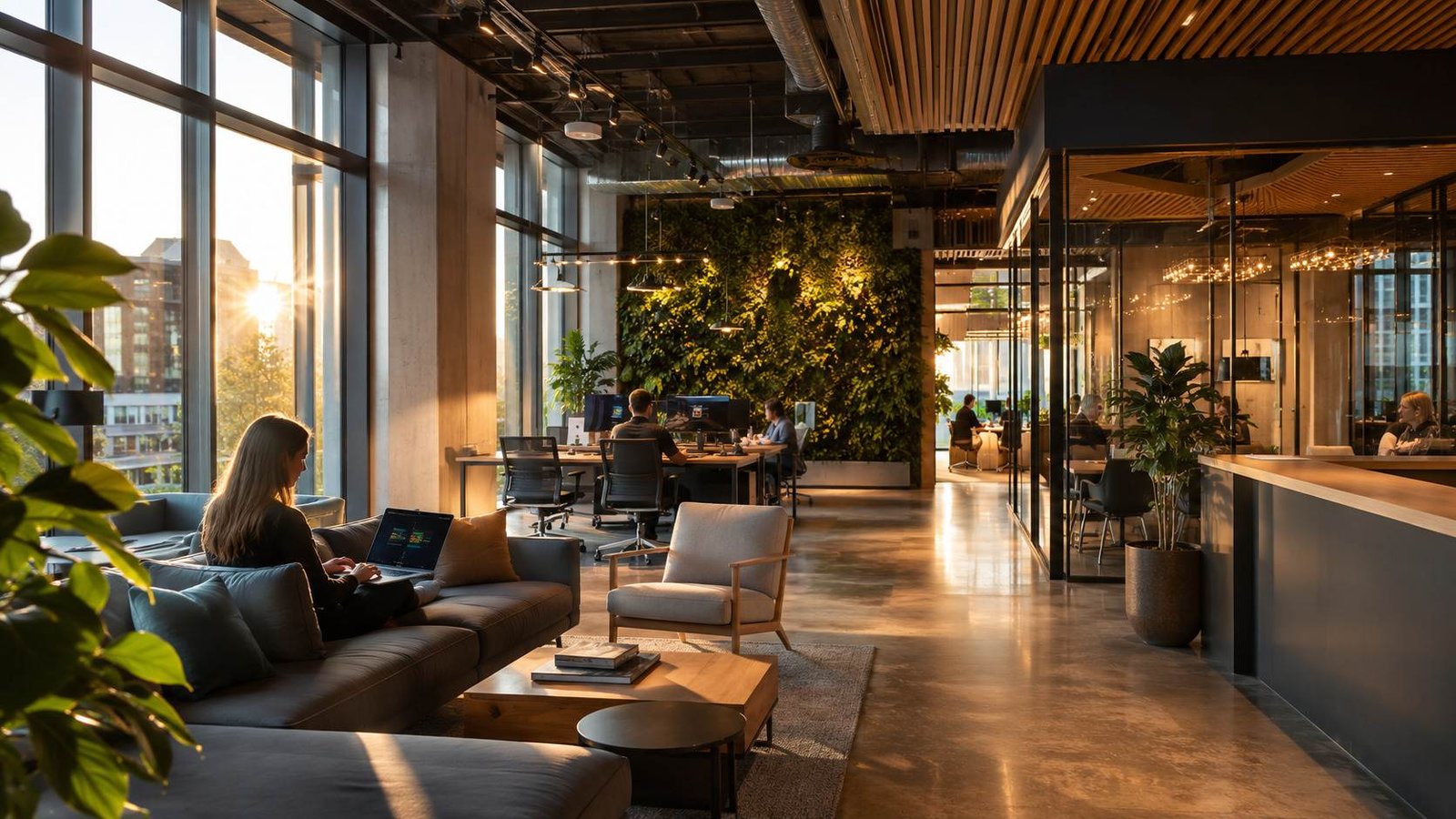
I’ve lost count of the number of business owners who’ve told me, somewhere around the third meeting, that they thought interior design was the easy part. The lease was the hard negotiation, the contractor was the big check, and the design was supposed to be the fun bit where you pick colors. Then they watch a poorly planned floor cost them a sales team’s focus, or a badly sequenced kitchen choke a restaurant’s Friday night, and the lesson lands.
Commercial interior design isn’t decoration. It’s the part of the building that decides how the business inside it behaves. That’s the whole game, and most of the costly mistakes I’ve seen trace back to someone forgetting it.
This guide is for the people who carry the consequences of those decisions. Owners signing leases. Facility managers defending a capital budget. Investors trying to make a shell leasable. Operators who know their business better than anyone but have never run a build-out and don’t want to learn the expensive way. I’ll keep the textbook stuff short and spend the time where it earns its keep.

So What Is Commercial Interior Design, Really?
Strip away the jargon and it’s this: planning and outfitting the inside of a business space, whether that’s an office, a store, a restaurant, a clinic, a hotel, or a coworking floor, so the space helps the business succeed instead of quietly working against it.
The reason it’s harder than residential work isn’t square footage. It’s that commercial spaces have to answer to a business question at every turn. A bedroom only has to please the person sleeping in it. A retail floor has to move shoppers past the right products, survive a thousand customers a week, meet code, reflect the brand, and still come in on budget. Three forces are always pulling against each other on a commercial project: how it looks, how it works, and what it costs to build and run. Good design is mostly the discipline of balancing those three without pretending you can ignore any of them.
Why Commercial and Residential Design Aren’t the Same Job
People assume a great residential designer can just scale up. Sometimes they can. Often they can’t, and the gap shows up in the details that don’t photograph: the fire code, the accessibility clearances, the flooring that needs to last the full lease under heavy traffic.
| Factor | Commercial Interior Design | Residential Interior Design |
| Goal | Business performance and brand | Personal comfort and taste |
| Users | Often hundreds a day | One household |
| Codes | Strict: ADA, fire, occupancy | Lighter residential rules |
| Materials | Commercial-grade, built to last | Residential-grade |
| Stakeholders | Owner, staff, landlord, contractors, inspectors | Homeowner |
| Money | Capital investment with a return | Lifestyle spending |
| Timeline | Tied to a lease, unforgiving | Flexible |
If you take one thing from this section, take this: hire for sector experience, not just talent. A designer who does stunning homes is not automatically your best choice for a 15,000-square-foot office, and the difference will surface at the worst possible moment, usually during permitting.
What a Commercial Interior Designer Actually Does All Day
The job clients picture is choosing finishes. The job that actually fills the week is making trade-offs under pressure.
A commercial interior designer programs the space (works out what you genuinely need versus what you think you need), plans the layout, specifies materials and lighting and acoustics, handles the furniture, fixtures, and equipment that the trade calls FF&E, runs procurement, keeps the project inside code, and coordinates with the architect, engineers, and general contractor while the thing gets built. On a big job they’re orchestrating specialists. On a small one they’re doing most of it themselves.
Here’s the part nobody warns you about. A designer can fall in love with a tile, spec it, and then find out it carries a fourteen-week lead time against your ten-week opening. Now it’s not a finish decision, it’s a schedule crisis. Half of good commercial design is anticipating those collisions before they happen. The best designers I’ve worked with are quietly obsessed with lead times and code clearances, not just mood boards.

The Money Question Most People Ask First
Let’s not pretend cost isn’t the elephant. People want a number, and the honest answer is that the number depends on what kind of space it is, what condition it’s in, and where in the country you’re standing.
Broadly, a basic office refresh in the U.S. starts around forty dollars a square foot. A premium office build-out can run past three hundred. Restaurants and healthcare spaces usually sit higher than offices, not because the finishes are fancier but because the mechanical, electrical, and plumbing work and the code requirements are brutal. Designer fees typically add somewhere in the range of eight to twenty percent of project cost, though they get structured several different ways.
Costs have been climbing lately. Labor shortages, material prices, and tariffs have all pushed fit-out budgets up, and North America is now the most expensive region in the world for office work. Benchmarks from firms like JLL put a moderate, medium-quality U.S. office fit-out near the top of the ranges below once you fold in design fees, engineering, and furniture. That’s exactly why a bare per-square-foot quote can mislead you. The first question to ask any number is: what scope does that actually cover?
What It Costs by Space Type
The biggest single driver of cost is what you’re building. The ranges below draw on 2025 and 2026 U.S. fit-out cost guides published by commercial real estate firms such as JLL and Cushman & Wakefield, and they’re meant for early planning, not a quote. Specialized clinics and fine-dining rooms can blow past the top end.
| Property Type | Typical Fit-Out (per sq ft) | What’s Driving It |
| Office, basic refresh | $40 to $75 | Light finishes, little reconfiguration |
| Office, mid-range | $75 to $150 | Custom workstations, meeting rooms, better finishes |
| Office, high-end | $150 to $300+ | Premium finishes, amenities, executive spaces |
| Retail, in-line store | $100 to $200 | Fixtures, lighting, branding; national average near $155 |
| Restaurant, full-service | $150 to $750 | Heavy kitchen systems, ventilation, durability |
| Fine dining | $300 to $1,000 | Premium finishes, custom millwork, complex systems |
| Healthcare, medical office | $150 to $300+ | Specialized plumbing, HVAC, infection control, code |
| Coworking, startup | $75 to $150 | Flexible furniture, shared amenities, lean finishes |
A couple of things worth knowing before you budget. A first-generation space, meaning a raw shell that’s never been built out, costs more than reusing an existing fit-out, so factor that in when you’re comparing two lease options. And geography swings these numbers hard. The same scope of work that pencils out in Nashville can cost dramatically more in San Francisco, New York, or Boston, where labor alone changes the math.
How Designers Charge, and Which Way Suits You
Two firms can quote the same project four different ways, which makes apples-to-apples comparison harder than it should be. Knowing the structures helps.
| Fee Structure | How It Works | When It Fits |
| Percentage of project cost | Around 8 to 20% of total build | Larger projects with real construction |
| Cost per square foot | A set rate times the floor area | Standardized or repeatable spaces |
| Hourly | Often $100 to $250+ for senior staff | Small or loosely defined scope |
| Flat fee | One agreed price for a defined scope | When you want budget certainty |
My own bias, for what it’s worth: on a well-defined project, a flat fee protects you better than an hourly rate, because it puts the risk of overruns on the side that controls the hours. On a vague or evolving scope, hourly is more honest for everyone. Be suspicious of a firm that insists on one structure regardless of the project.
The Budgeting Lessons That Actually Save Money
A few habits separate the projects that finish on budget from the ones that bleed. Keep a contingency of ten to twenty percent, because surprises behind walls aren’t bad luck, they’re the norm. Make your decisions during design, where a change is cheap, instead of mid-construction, where the same change can cost many times more once walls are framed and materials are ordered. On the right project, modular or prefabricated elements can cut both cost and schedule meaningfully. And don’t reflexively treat efficient systems as overspending; the higher upfront cost on lighting and HVAC often pays itself back in operating savings over a lease.
The cheapest project is almost never the lowest bid. It’s the one with the fewest mid-construction surprises, and you buy that with planning, not luck.
Why This Is an Investment, Not an Expense
I understand the instinct to treat design as a cost center. It sits on the capital line, it’s a big check, and the benefits feel soft. But the benefits aren’t actually soft once you look at them. They’re just slower to show up than the invoice.
The clearest evidence is in workplaces, where the link between daylight and performance has been studied for decades. The most-cited example is Lockheed’s Building 157 in Sunnyvale, a daylight-focused office from the early 1980s. After the move, the company reported roughly a fifteen percent drop in absenteeism, enough to help pay back the building, and that case is still referenced today, including by the American Institute of Architects. It’s an old story, and parts of it rest on the company’s own accounts rather than a controlled trial, so I wouldn’t lean on the exact number. What makes it worth mentioning is that the same pattern, better light and better air tracking with fewer sick days and sharper focus, keeps turning up across later research. The flip side is just as consistent: studies on noise have long shown that uncontrolled background sound drags down concentration and cognitive performance, which is exactly what you’d expect from anyone trying to write in an untreated open room.
Picture a forty-person firm packed into one open floor with no acoustic treatment. People lose focus all day to overheard calls, and the ones who can’t tune it out start working from home just to think. Adding a few phone booths, a couple of quiet rooms, and some ceiling treatment is a rounding error against forty salaries, and it buys back real productive time and makes people want to come in. That’s the actual return, and it doesn’t show up on the construction estimate.
The same logic runs through the customer side of the business, just with different math.
Layout as a Sales Tool
Anywhere customers spend money, the floor plan is selling for you or against you. Retailers figured this out generations ago. The entry is a decompression zone where nobody buys anything yet, so you don’t waste it on your best product. The path pulls people past high-margin displays. The sightlines keep them moving deeper instead of bouncing.
A common one: a store keeps its highest-margin accessories near the entrance, exactly where shoppers are still adjusting to being inside and not yet buying. Move that product onto the natural path toward the fitting rooms, where people have already committed, and attachment sales tend to climb. Same inventory, same rent, better choreography. Retail design is mostly a long argument about where the eyes go and where the feet follow.
Restaurants run on the same idea with harsher consequences, because every inch of the floor is a fight between guest comfort and covers per night. A typical fix for a sluggish turn has nothing to do with adding tables: widen one pinch point in the server path, relocate the point-of-sale station, and servers cycle faster, tables turn faster, and the room does more covers in the same hours. In a restaurant, the back-of-house geometry you can’t see from your table is where the margin lives.
Your Space Is Your Brand, Read in Three Seconds
People judge a business the moment they walk in, long before anyone speaks. A law firm with worn carpet and mismatched chairs undermines the stability it’s charging for. A wellness studio under harsh fluorescents contradicts its own pitch before the client sits down. The reception and the first twenty feet do an outsized share of the trust-building, and they’re cheap real estate to get right relative to their impact.
The Quiet Wins: Operating Cost and Space You’re Wasting
Two benefits get overlooked because they’re undramatic. The first is operating efficiency. Durable flooring that doesn’t need replacing mid-lease, lighting and HVAC zoning that trims the utility bill, layouts that cut wasted staff steps, finishes that wipe clean instead of staining. None of it is exciting. All of it shows up month after month after the construction crew is long gone.
The second is space you’re paying for and not using. Look honestly at how a floor performs and you’ll usually find a meaningful share of it working badly, lost to dead circulation, oversized private offices nobody needs that big, or meeting rooms that sit empty most of the day. Utilization studies have long shown that average desk and meeting-room occupancy runs well below capacity in most offices, and hybrid schedules have only widened that gap. With rent and fit-out costs where they are, right-sizing the footprint or making the same footprint do more is one of the fastest returns available. Sometimes the most valuable thing a designer can tell a client is that they’re leasing too much.
How a Project Actually Unfolds
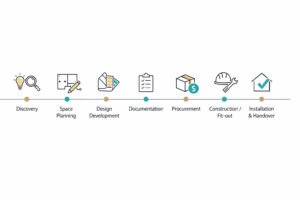
Every firm has its own language for the phases, but a commercial project moves through roughly the same arc, and knowing where the slips happen helps you avoid them.
It starts with discovery, which is the part too many people rush. The designer is learning your headcount, your growth plans, your workflow, your brand, your budget, and the feeling you want the space to produce. Shortchange this and you pay for it later in change orders, because the design was solving the wrong problem from the start.
Then comes space planning, the analytical heart of the whole thing. Occupancy, circulation, zoning, how many desks or seats or rooms you need and where they belong. This is where a designer either builds in flexibility or accidentally locks you into a layout that breaks the first time you grow.
Design development is where it gets visual, with layouts and materials and lighting shown through models built in SketchUp, AutoCAD, or Revit. It’s also the last cheap moment to change your mind, which matters more than it sounds. Documentation turns the design into the drawings a contractor prices and builds from, and tight documents protect your budget by leaving less open to a contractor’s interpretation on-site.
Procurement is where lead times bite. Furniture is a classic culprit for a blown opening date, so the long-lead items get ordered early or they sink the schedule. Construction, the actual fit-out, is where the designer earns the coordination fee, fielding the daily on-site calls that no drawing fully anticipated. And then installation and the punch-list walkthrough, the unglamorous final stretch where the difference between good and sloppy gets decided.
As for how long all this takes: a small refresh might run six to twelve weeks, while a full corporate, restaurant, or healthcare fit-out can stretch from six months to well over a year once permitting and procurement are in the mix. Permits and furniture lead times cause most of the delays I’ve seen, and both are entirely foreseeable, which is the frustrating part.
Planning the Layout, and Picking a Model
Space planning is where the budget gets respected or wasted. A gorgeous space that works badly is a failure, full stop, no matter how it shoots for the brochure.
It all starts with flow. How do people move between desks and rooms and the break area? Where does everything jam up at peak? Smart zoning groups what belongs together, keeps the paths clear, and hands the best real estate, which usually means the daylight, to the people and activities that benefit most. The big shift over the last few years is that fixed one-person-one-desk layouts stopped making sense for most companies once hybrid schedules meant the floor was rarely full.
One of the first real choices is which layout model to build around, and each one trades something away.
| Layout Model | Best For | Strengths | The Catch |
| Open plan | Collaborative teams, startups | Lower cost per person, easy to reconfigure, shared daylight | Noise and distraction if untreated |
| Private offices | Law, finance, confidential work | Privacy, focus, status | Costs more per person, wastes space |
| Activity-based / hybrid | Most modern offices | Matches space to task, efficient under variable attendance | Needs a booking culture to work |
| Coworking / shared | Startups, satellite teams | Flexible cost, scalable, amenity-rich | Less brand control |
For most knowledge-work companies today I’d lean toward an activity-based approach, but with a real caveat: it only works if leadership backs the behavior change. Build a beautiful activity-based floor and let people keep treating desks as their personal territory, and you’ve spent money to recreate the old problem with better furniture. Design and culture have to move together or neither moves.
How the Thinking Changes Across Industries
Every sector has its own physics. The principles rhyme, but the stakes and the pressure points shift.
Offices are a constant negotiation between focus and collaboration. The best ones layer both, with open zones for working together, enclosed rooms for getting away, video-ready meeting spaces with acoustics that actually work, and breakout areas where the unplanned conversations that build culture happen. There’s a pattern that repeats whenever a company moves from private offices to open plan: morale dips in the first month, and people assume openness was the wrong call. Usually it wasn’t. The real mistake was removing enclosure without giving anyone a quiet place to retreat to. Add a handful of focus rooms and phone booths and the complaints tend to fade. You can’t take privacy away from people without handing it back somewhere else.
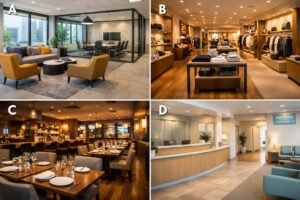
Retail, as I said earlier, is applied sales psychology, and small layout moves shift real money. Restaurants are the most operationally demanding interior there is, because the dining room is part of the meal and yet every design choice collides with seating capacity, kitchen flow, acoustics, durability, and turnover. Push the seating density too hard and you kill the experience people came for. Go too soft and the economics quietly fail.
Hospitality is its own thing entirely, built around a sense of place and escape, where the guest should feel the brand from the lobby to the room while housekeeping efficiency and durability matter just as much behind the scenes. Hotels often set trends the rest of us borrow later, which is partly why the warmer, homier feel keeps migrating into offices.
Healthcare is where comfort and clinical reality have to share a floor plan. Infection control, strict codes, accessibility, wayfinding, and patient stress all live in the same drawing. Calming palettes, daylight, and clear navigation aren’t soft touches here. A patient who can’t find the lab is a worse experience and a drag on staff, and the wrong finish can fail an inspection. These interiors are among the priciest to build for exactly these reasons.
Startups and coworking spaces are an exercise in doing a lot with a lean budget, where adaptable furniture, multi-use rooms, and strong branding have to recruit talent and signal momentum without burning capital the business needs elsewhere. And small businesses, often working with the least money of anyone, prove the point that good design isn’t about budget. Smart layout, durable affordable materials, decent lighting, and clear branding can make a modest space feel genuinely professional, and for a small business the interior is frequently the cheapest competitive edge there is, because a customer’s read on quality forms the instant they walk in.
The Pieces That Carry the Most Weight
A finished space is hundreds of coordinated decisions, but a handful punch above the rest, and each one has a consequence past how it looks.
Lighting does more for mood, focus, and how a space reads than almost anything else, and it’s the thing most often gotten wrong on a tight budget. Layered light, ambient plus task plus accent, with as much daylight as the space allows, keeps people comfortable and cuts the energy bill. Bad lighting just quietly produces eye strain and fatigue that drag on productivity all day.
Acoustics are the most underrated factor in the whole field. Noise is what people complain about months after move-in, and by then it’s expensive to fix. Treat it as a primary layer from the start, with panels, soft finishes, sound-absorbing ceilings, and dedicated quiet zones, rather than a patch you apply after the complaints arrive.
Flooring has to survive the traffic while carrying the look, and reaching for residential-grade material to save a few dollars is a false economy that comes back as a replacement bill within a couple of years. Glass partitions define space without killing daylight. Custom millwork delivers the storage, reception desks, and brand moments that off-the-shelf can’t touch. Furniture is where ergonomics, looks, and budget all meet, and quality commercial pieces tested to the durability and safety standards set by BIFMA, the trade association for commercial furniture, earn their cost over a long lease through durability and the simple fact that comfortable people work better. Color and branding tie it together, weaving identity through finishes and signage so the space reads unmistakably as yours.
Where the Trends Are Heading
A few directions are shaping current U.S. projects, and most of them are reactions to how work and customer expectations have changed rather than fashion for its own sake.
Flexibility is the headline, and in practice it means designing around how full the floor actually gets rather than headcount on paper. Companies running hybrid schedules are setting desk-sharing ratios, often somewhere between one desk for every one-and-a-half to two people depending on attendance patterns, and backing that with bookable desks and rooms, modular furniture, and demountable partitions so a zone can change function without a contractor. The payoff is concrete: less square footage leased, or the same footage supporting more people.
Biophilic design has moved past the token potted plant. The version that earns its cost puts greenery, natural materials, and especially daylight where people actually sit, pulling workstations toward the windows and reserving the dim interior for circulation and storage rather than burying staff in it. The wellbeing and focus gains behind this are among the better-documented in the field, which is why it keeps spreading rather than fading. Wellness more broadly has shifted from perk to baseline, showing up as real attention to air quality and ventilation, ergonomic seating and sit-stand desks, and layouts that get people moving during the day.
Sustainability is becoming the default, partly for the operating savings and partly because tenants now screen for healthy, certified buildings, which makes a certified space easier to lease and, for owners, more valuable. The warmer, more residential look keeps gaining ground because companies are using design as a reason for hybrid staff to choose the office over the kitchen table, so comfort and good coffee and soft seating are doing real recruiting work. And technology is being designed in from the start instead of bolted on, with room-booking systems and occupancy sensors that tell facilities teams which spaces are wasted and which are overrun, turning guesswork about the next renovation into data.

Sustainability and Code: The Unsexy Stuff That Pays
Sustainability usually gets pitched as the right thing to do for the planet, which is true and also not the argument that moves most owners. The stronger case is financial.
Chasing standards like LEED, the U.S. Green Building Council’s rating system focused on environmental performance, or the WELL Building Standard, run by the International WELL Building Institute and aimed squarely at human health inside the space, pushes you toward efficient lighting, low-emission materials, and better daylight. The payoff stacks up in ways that aren’t really about carbon: lower running costs over the lease, healthier staff and the lower absenteeism that follows, stronger leasing appeal because tenants now pay attention to building health, higher asset value, and insulation against building codes that keep tightening. You can pursue most of these benefits informally without ever filing for a plaque on the wall.
Compliance is less negotiable. Commercial spaces have to meet building codes, ADA accessibility standards, and local fire and occupancy rules, and universal design takes it further by making the space inclusive by default. The practical lesson is short and expensive to ignore: build compliance in from day one. Finding an accessibility or code problem during construction costs many times what it would have cost to design around it, and inspectors don’t grade on effort.
Choosing Who to Hire
This decision matters more than most clients realize, because the wrong fit costs time and money and goodwill, and the right one feels like a quiet extension of your own team.
Sector experience is the filter I’d apply first. A firm that builds gorgeous restaurants is not automatically right for a medical office, because the codes, the systems, and the operational logic are genuinely different worlds. When you review a portfolio, look for projects close to yours in type, scale, and budget, not just ones that are pretty. Pretty is table stakes.
Past that, you’re looking for a clear process, real command of codes and accessibility, the ability to actually manage procurement and contractors, references you can call, and a collaborative streak. Be wary of the firm that stamps the same signature look on every client regardless of their business. Before you sign anything, ask how they structure fees and what’s included, who your day-to-day contact will be, how they handle change orders and delays, what a realistic timeline looks like for your project, and whether they’ve done work in your industry. Vague answers are a warning. Specific, confident ones are a good sign.
Build for the Business You’re Becoming
The best spaces are designed for the company you’ll be in three years, not just the one signing the lease today. Headcount moves, attendance fluctuates, retail concepts evolve, clinics add services. Designing in some flexibility from the start is far cheaper than renovating later, and it’s one of the higher-return decisions in the whole project.
In practice that means modular furniture that reconfigures without a contractor, demountable partitions instead of fixed walls where change is likely, power and data run with spare capacity, and rooms that flex between uses. The company that designs a floor for exactly its current thirty people and then hires fifteen more pays twice, once to build and once to rebuild. A little spent on adaptability up front beats a lot spent tearing things out later.
The Mistakes I Watch People Repeat
The expensive errors are predictable, which is what makes them frustrating. People chase looks over function and end up with a space that photographs beautifully and works badly. They lowball the budget and skip the contingency, then act surprised when the wall opens up and there’s a problem behind it. They ignore acoustics until the complaints start. They cut corners on lighting. They design only for today and forget they’re trying to grow. They treat ADA and code as an afterthought and pay for it at inspection. And they buy residential-grade materials that simply can’t take commercial wear.
Every one of those traces back to the same root: deciding without really thinking through how the space gets used, day after day, for the length of the lease. Design that ignores daily reality always sends the bill eventually.
Common Questions, Answered Plainly
What does a commercial interior designer actually do? They turn business goals into a built space, handling layout, materials, lighting, furniture, branding, and code, then coordinating with contractors to build it. The point is a space that looks right and helps the business run better, not just one that looks good in photos.
What does it cost? In the U.S., interior fit-outs generally run from about forty dollars a square foot for a basic office refresh to over three hundred for premium offices, with restaurants and healthcare usually higher because of specialized systems and code. Designer fees tend to add eight to twenty percent of project cost.
How long does it take? A small refresh might take six to twelve weeks. A full corporate, restaurant, or healthcare fit-out can run six months to over a year. Permits and furniture lead times cause most delays, so start both early.
Is it worth the money? For most businesses, yes. Better layout, daylight, acoustics, and branding measurably improve productivity, retention, customer behavior, and property value, and those gains usually outrun the upfront cost over the life of a lease.
How is commercial design different from residential? It serves a business and many users, meets far stricter codes and accessibility standards, uses durable commercial-grade materials, and gets judged on business outcomes. Residential design is about the comfort and taste of one household.
Can a small business afford it? Yes, and arguably small businesses get the most out of it. Smart layout, affordable durable materials, good lighting, and clear branding can make a modest space feel genuinely professional, often for a fraction of what owners expect.
What’s a tenant improvement allowance? Money a landlord puts toward customizing your leased space, usually quoted per square foot. It rarely covers the whole build-out, so your real cost is the build-out minus the allowance. Negotiate it before you sign the lease, not after.
How do I cut costs without cutting quality? Lock your decisions during design where changes are cheap, hold a contingency, favor an existing fit-out over a raw shell when you can, look at modular elements, and spend on durable materials and efficient systems that lower what the space costs to run.
The Bottom Line
Commercial interior design isn’t a layer of polish applied over a business. It’s part of how the business works. The layout shapes how a team performs. The light and the acoustics shape how people feel and focus. The flow shapes how customers behave. The finishes shape how the brand reads and what the space costs to run for years. Get those right and the space quietly pays you back every day. Get them wrong and you cover the mistake every day instead, which is the more expensive option dressed up as the cheaper one.
The companies that do this well usually aren’t the ones with the deepest pockets. They’re the ones who start from how the space needs to function, plan for who they’re becoming, treat cost and code honestly, and respect the project for the long-term investment it is.
If Your Space Isn’t Pulling Its Weight
You probably already have a sense of whether your office, store, restaurant, or property is working as hard as it should. If it isn’t, that’s a fixable problem, and the first move costs nothing but a conversation. Whether you’re looking at a full fit-out, a remodel, or a focused refresh, sitting down with a qualified commercial interior design firm and walking your actual space is the fastest way to see what it could become. Find someone with real experience in your kind of business, ask the hard questions early, and start there.